
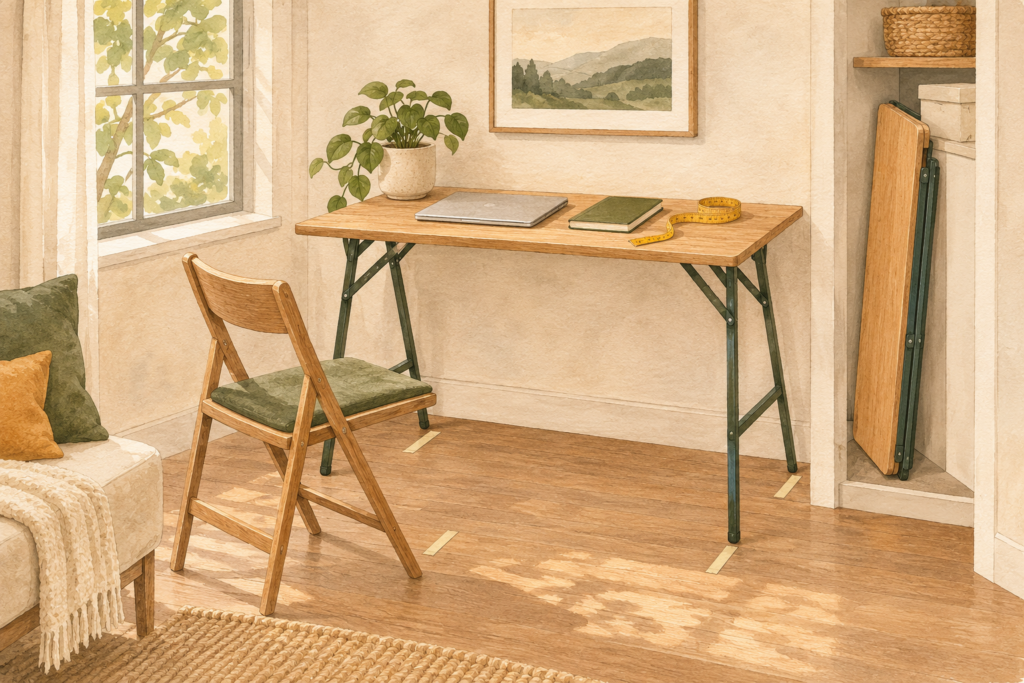
A folding desk can solve a space problem and still create another one: nowhere to put the chair, a blocked drawer, or a folded tabletop that has no proper home. Before comparing finishes or prices, plan the whole setup.
This is a planning guide, not a hands-on product test. If you follow an affiliate link on Tiny Nest Homes, we may earn a commission from qualifying purchases at no extra cost to you. Read our disclosure.
1. Map the space you actually have
Choose the exact wall or corner where the desk would stand. Record the usable width and depth after accounting for skirting boards, radiators, door swings, and furniture you intend to keep. A room’s total floor area does not tell you whether a particular desk will work.
Mark the proposed tabletop footprint with removable tape or pieces of paper. Place your existing chair behind it and try sitting down, standing up, and moving around it. Keep the usual route through the room available.
2. Measure three versions of the desk
- Working: tabletop width, depth, and height, plus the space your chair needs.
- Folding: the space needed to move the legs or tabletop through their folding motion.
- Stored: the folded dimensions, including feet, hinges, or handles that project beyond the top.
Ask the seller for any missing measurement. A description that says “compact” or “space-saving” does not establish whether it will fit your home.
3. Give the folded desk a real address
“Behind the sofa” is a useful plan only if you can reach that space without moving the sofa every morning. Measure the storage opening and the narrowest part of the route to it. Think about whether you can move the desk comfortably and store it according to the manufacturer’s instructions.
If folding it away takes several awkward steps, you may prefer a small permanent desk. The better choice is the setup that supports your routine.
4. Plan the chair, screen, and cables together
List what must stay on the surface: laptop, monitor, keyboard, notebook, lamp, or charging equipment. Re-create their arrangement on your current table. This gives you a practical minimum surface to compare against retailer measurements.
Check the desk’s stated load capacity and installation or use instructions. Plan cables so they do not run through a hinge or become trapped when folding. For a wall-mounted model, confirm suitable mounting arrangements with an appropriately qualified installer.
5. Compare everyday effort, not just dimensions
| Question | Your answer |
|---|---|
| Where will the chair go? | Write a specific location. |
| Where will work supplies live? | Name one drawer, shelf, or portable box. |
| How often will the desk be folded? | Daily, occasionally, or rarely. |
| What must be disconnected? | List every cable or accessory. |
| What happens when guests arrive? | Describe the complete reset. |
6. Make a useful shortlist
Compare two or three exact models using the same notes. Record the source link, model name, date checked, working and folded dimensions, stated load limit, included parts, delivery costs, and return terms. Verify those details at the current manufacturer or retailer listing before purchasing.
A lower price is less useful if the desk cannot be returned conveniently or if essential mounting parts cost extra. Keep the total setup cost in view, including the chair and any storage you genuinely need.
Your final check
Before ordering, walk through a normal day: unfold the desk, sit down, use your equipment, pack it away, and move through the room. If that sequence works on paper and with a taped-out footprint, you have a more useful basis for choosing than a staged product photograph.
For more ways to make a compact room work, explore our small-space ideas.