
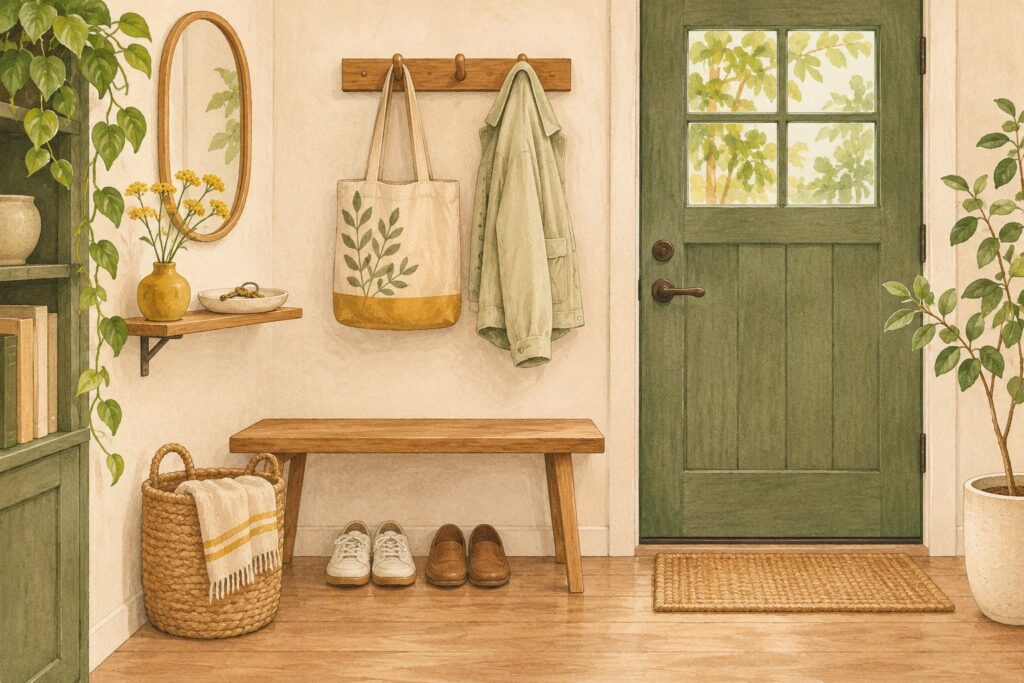
A small entryway has a demanding job. It handles the things you carry in, the things you forget on the way out, and the shoes that seem to multiply overnight. A useful reset begins with a few clear decisions about what belongs there.
You can try this plan with a timer, a bag for items that belong elsewhere, and storage you already own. There is no shopping list to complete first.
Minutes 0–5: Clear the route
Open the door fully and notice where it swings. Move bags, shoes, boxes, and loose objects out of that path. Keep door operation and access routes clear. If you are considering mounted storage, check the product instructions, wall suitability, and any rental restrictions before installing it.
Put everything you have removed in one temporary sorting area. Avoid spreading the task into several rooms at once.
Minutes 5–10: Sort by the next use
Make three groups: items used most days, things used occasionally, and items that belong elsewhere. Return the last group to its proper room. Decide where occasional-use items can live without competing for the most convenient entryway space.
Set a realistic shoe limit for the entrance. That might mean one everyday pair per person rather than every pair the household owns. Use your household’s routine to choose the limit.
Minutes 10–15: Create three landing places
- Keys and small essentials: choose one shallow tray, dish, or existing drawer.
- Bags and outer layers: choose a place each person can reach and use easily.
- Incoming paper: choose one small container that you will empty regularly.
Keep unrelated categories separate. Keys are easier to find when they are not hidden beneath receipts, charging cables, and spare gloves.
Minutes 15–20: Try storage you already own
Test a basket from another room, a spare tray, or a shelf that is currently underused. Set it up temporarily and walk through the routine of coming home. Can you put down a bag without moving another item? Can someone else pass while you take off your shoes?
If you need to buy something later, measure only after this trial. Record the available width, depth, and height, plus any door swing and access space. A narrow cabinet can still interfere with a doorway when its own door is open.
Minutes 20–25: Make the system easy to understand
Give every everyday object one obvious home. A simple label can help in a shared household. Put the things used together near one another, such as a bag and the essentials that leave with it.
Choose a paper routine: open, act, file, or recycle. Keep sensitive documents in appropriate private storage rather than leaving them visible near the door.
Minutes 25–30: Rehearse leaving the house
Pick up your keys, bag, shoes, and outer layer as if you were heading out. Notice any extra movement: opening a blocked drawer, lifting one bag to reach another, or walking to a second room for something essential.
Adjust the arrangement once, then leave it in place for a week. A system needs a chance to meet your normal routine before you replace it.
A two-minute evening reset
- Return the everyday essentials to their landing places.
- Move extra shoes and bags out of the entrance.
- Deal with the small paper container before it overflows.
If the entrance keeps filling up, reduce what lives there or move a category elsewhere. A larger basket can hide the same unresolved decision.
When a purchase would help
Buy only for a specific problem you observed during the week. Compare exact dimensions, capacity, wall or floor requirements, care instructions, and return terms at the seller. This guide does not claim hands-on testing of a particular storage product.
For related inspiration, see our entryway design ideas and our simpler-living guides.